Wednesday, May 29, 2013

Color Classic V. Silly Symphonies Pt.2: The Rambling Conclusion...

Welcome back to my brain. It's scary in here. 


Back again to wrap up my series of posts on the oft maligned Fleischer Color Classics. In my previous post I ran down all the color series of the '30's in the order in which they appeared  with  the Fleischers falling roughly in the middle of the Silly Symphony-like craze that exploded during the mid-thirties. That in itself is not important to the subject of this post.  What I am referring to is not only  how the content and approach of the Color Classics  differ from the Silly Symphonies but how they fit, logically, into the overall history of Fleischer Studios. 

In terms of advertising there was no-one to beat Disney. Still, the Fleischers produced some gorgeous ads and posters for their cartoons. Image: Greenbriar Picture Show.


One of the things that I think is important is how attitudes and aims towards animation differed at the two studios. From the accounts of the animators who worked there, Disney was a place which strove to draw a direct line between life drawing and life animation. The films of the 30's, and particularly the Silly Symphonies, are often described in terms of their training value.  Of course, any animator of note who worked during the brutal golden age of animation had  professional art training. The difference at Fleischers was what that meant and how it effected the films.   The above entry in 'The Animated News' sheds some light on what I mean. Reading down from left to right  you will see a gradual change in opinion from "I have known people who have become good animators without any art school education"   to "No one can have too much art school training". In between Sparber and Waldman sweat it out. Like everything else in The Animated News the spirit is always in fun and is intended to be humorous as well as informative. All the same, Max's comments suggest a certain humility consistent with his letter, reprinted in my sidebar,  to animator Shamus Culhane. 

Is this blue collar enough for ya? A neighborhood so dangerous that weapons fall from the sky. Row! Row! Row! (Screen Song1930)

  Without any sort of corroboration (check my first post back in 2007: this blog has always been my opinion not a sworn-on-a-stack-of-bibles history lesson) I've always suspected this may have been because Max saw his studio as a maker of comedy shorts. Just as Mack Sennett or Hal Roach (two studios which also encouraged a familial working atmosphere)  approached the content of their short subjects in an unpretentious kind of way, so too I believe Max approached the making of his cartoons. Comedy as it applied to the silent and early sound era was often broad. Movies were generally the entertainment of the working class and poor who liked to see themselves reflected in the entertainment they consumed.  Hailing as they did from working class and poor backgrounds it wasn't difficult for the Fleischer artists (aided by Dave Fleischer) to oblige in creating comic situations that would have been completely foreign, or at least distasteful, to the deans of higher culture  as they existed in the early 30's. While professional art training was an essential ingredient, the Fleischer cartoons took their inspiration not from the academy but from working class entertainments such as vaudeville, burlesque, dime museums, circus sideshows and others. As it happens this lineage is also an essential part of appreciating  the less apparent values of the Color Classics.

What th' hell is this? Terry-eyed pigs dance like idiots in 'Three Little Pigs'.

So, when 'The Three Little Pigs' opened to rave reviews and box office busting returns, it must have come as a bit of a shock to the Fleischer artists. The Silly Symphonies which directly preceded it were unremarkable, and comedically slight,  so there was no reason that they that they should have seen a threat. The business was changing though as the production code began to be enforced. Though introduced in 1930, most of the Hollywood studios didn't actually begin to implement the code until 1934: the first year the Color Classics. So, at the very same time the Silly Symphonies were being lauded for their wholesome and code-friendly content (a message shrewdly echoed in  Disney educational cross-promotion), the Fleischers found themselves faced with two problems: to clean up their existing series and to launch a new one in a in a style with which they weren't familiar.  

Gag cartoon from the Animated News shows animators falling like soldiers before 'The Curse'.

However, more things were changing direction at Fleischer's than just the cartoons. A quick scan through The Animated News, which ran during the height of The Color Classics, indicates the mid thirties as a time when a lot of  Fleischer artists were getting married and starting families.  At this point, babies and little kids not only started appearing regularly in the animated films but  in the personal greeting cards and gag cartoons exchanged by animators. In fact one recurring Animated News feature, 'Down Studio Lane', dedicated itself almost exclusively with romantic gossip and wedding announcements.  Something must have been  softening as artists rushed home after work to be with spouses  and children for the first time in their lives.  In that sense it's not surprising that a sentimental series like the Color Classics should have been created around this time.

Domesticity comes to the wild men of Fleischers.  1936 issue of The Animated News


Yet there remained a giddy freakishness to the films. While the Silly Symphonies  pressed  further towards a more studious and realistic approach, the Fleischer artists continued to draw upon the same none-too-wholesome influences as they had for years.  After all, Fleischer Studios was a part of a larger New York commercial art export (which included two other animation studios as well as being the nexus of advertising and newspaper comic strip work) that had come to define comic drawing in the years since the turn of the century. This definition automatically accepted the grotesque as both humorous and a draw for the curious.   The Fleischer style was not one deliberately mandated, as with Disney, but one which had evolved slowly over many years of different artists absorbing from each other within this particular milieu. Unfortunately, it's the way that  this funny style of drawing  came to be used that has caused much of the confusion in some latter day assessments of the Color Classics. While some of the cartoons are clearly tongue in cheek, as with 'Fresh Vegetable Mystery''Greedy Humpty Dumpty' and 'Chicken a la King', others follow a straight sentimental narrative as with 'Somewhere in Dreamland''Song of the Birds' and 'Musical Memories'  yet all are drawn in variants of the same style.  So, on the whole,  the messages sent by Color Classics are decidedly mixed. 

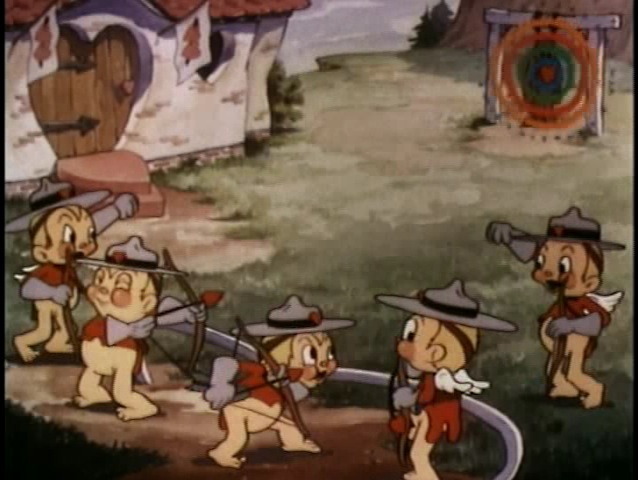
Practically every studio did a variation on the cherub but only Fleischers covered theirs in so many loving wrinkles. 'Song of the Birds' (1935)


'Greedy Humpy' (a character modeled after Dave Fleischer!) begs the question: who ate who first-the chicken or the egg?


Jack Mercer delivered a truly disturbing vocal performance (a cross between Popeye and Mae West) as 'Ducky Wucky' in 'Chicken a la King'. 

Meanwhile, at Disney, there was evidently no such contradiction. The Silly Symphonies had begun in the late 20's with real verve and comic life but by the mid-30's this approach was being phased out in favor of  a more realistically drawn style of movement.  Some had cohesive stories, others not. Many amounted to not much more than tableaus of cute animals or babies frolicking interminably for seven minutes. And all without the inventive gags or unusual set-ups that kept Color Classics from from being mired in a similar soup.   The animation had it's moments of inspiration, as with Max Hare, but also a choppy and forced quality. One thing about Fleischer characters is they always looked comfortable in the worlds they inhabited! Alternatively, Disney characters of the mid and even late 30's often appeared to be struggling to work themselves out of suits sewn two sizes too small. The term 'Silly Symphony' even lost  it's meaning for a while as the cartoons focused zealously on 'character' animation over any sort of musical constraint. 


Here's an expression I'd like to see less of in animated shows these days. 'The Robber Kitten' (1935) 

 'The Flying Mouse' (1934) looks wistfully at something.

By the late '30's the Silly Symphonies began to show the more polished animation look of the 40's. However, the overall Disney process was so deeply mired in naturalism, in the strictest sense, that a promising cartoon like 'Mother Goose Goes Hollywood'  ended up being handled in a highly prosaic manner. Other cartoons of that later period, like 'Barnyard Symphony' and 'The Ugly Duckling'  were so concerned with the study of real animal movement as to become  virtually mundane. Even the backgrounds began to resemble the sort of water colors one might find as plates in a botanical textbook of the late 19th century.  Academia had certainly come to Disney's - and how!

 A Disney animator tries to interpret Stan's subtle comic movement into a complex set of overlapping muscles. Yeesh. This kind of mistake still happens today and has sometimes been confused with 'the uncanny valley' effect.

This scene from the last Silly Symphony 'The Ugly Duckling' (1939) demonstrates how focused on naturalism the studio had become and how mundane the result.

Pathos was certainly new territory for the Fleischer artists.  All the same the Color Classics of the strictly cute/melodramatic variety are surprisingly effective thanks mostly to the ease, and simplicity, with which the artists delineated their work. If anything they stayed safely within the kind of movement and design that the artists found comfortable to work in. As a result, the cartoons do have a certain believability within the context of what they are. For some, however, excepting such story content told in the language of a Fleischer cartoon is difficult. For others, that such content should even exist in a Fleischer cartoon reeked of insincerity. But how is it that the Disney artists were so much more sincere? They were sincerely chasing realistic movement, that's for sure, but one wonders if they would have chosen such syrupy material as the Silly Symphonies had they been left to their own devices?

Cuteness in Fleischer cartoons was not without precident either. Many of the earlier Betty Boops and Screen Songs had, in fact, featured cute animals and situations. 'Small Fry' (1939)

 Tying it all together, of course, was the exceptional music. The Terrytoons, Walter Lantz, and Schlesinger cartoons could have lively scores but lacked nuance. At Columbia scores were reused with such regularity that even by the late 30's the cartoons were still using cues composed for the early Scrappy and Toby cartoons. The Disney scores had, in fact, inspired a derogatory term in the parlance of soundtrack composition: Mickey Mousing. This term, usually defined as the literal following of screen action with instruments, would later define most of Carl Stallings 1950's scores. Of course, Disney did have a handful of cartoons with with nuanced musical scores but most of them come off flat and ticky tacky sounding. Their period of great music was yet to come.

"AND I GOTTA A FEW OTHER THINGS TO SAY ABOUT THE COLOR CLASSICS!"


A review of 'Musical Memories' from The Fleischer Animated News was only half right. "Musical Memories is realistic in it's theme. In it's treatment it is high fantasy.

Definitely not realistic drawing. All the same, there is genuineness: a cartoon about good old New York by good old New Yorkers. 'Musical Memories' (1935)

'The Modernistic Home' mentioned in the review of Musical Memories above (taken from The Animated News) was, of course, a reference to a Fleischer invention that had come to be used more often in the Color Classics than any other Fleischer cartoon series: the tabletop camera. Often referred to in publicity as "The Third Dimensional Effect", the unique apparatus was first used in the 1934 debut Color Classic 'Poor Cinderella'.  The process must have offered a certain novelty over the competing Silly Symphonies as Disney himself would respond with a device of his own three years later (a downward variation of Iwerks' multi-plane camera) in 1937's 'The Old Mill'.  However, even in this element the object was always to give a more heightened reality to the films. This is a crucial difference: Fleischers' tabletop sequences were about heightening fantasy.

Clearly a cartoon world. Dancing on the Moon' (1935)

The Cinecolor  jungle and circus poster design of 'An Elephant Never Forgets' (1935) 

This is not to say the Color Classics were incapable of creating a serious mood. In fact the Fleischer cartoons of the early 30's could be extremely moody thanks to Erich Schenk and his crew. When it came time to make the switch to color, the background artists demonstrated as sophisticated an ability with color, to create mood, as they had with the limited tones of the black and white films. However, there also emerged a more cohesive cinematic approach with angles, wipes, cuts etc. chosen for their emotional impact as they never had before.  Many of these techniques would go on to influence the later Superman and Famous cartoons and can be seen as one of the vital links between the early and late period Fleischer styles.

A moody high angle shot from 'Hawaiian Birds'  (1936). Though rarely discussed there was quite a bit of experimentation going on in the Color Classics.

'Hawaiian Birds' 

"All's Fair at the Fair" (1938) anticipates the sort of art deco influenced science fiction elements which would give the later Superman cartoons their distinctive look.

Of course the series had it's crass copies, as all the studios did, of earlier Disney successes. I'm certainly not suggesting 'Peeping Penguins' (1937)  was conceived as much more than a knock off of the much earlier Silly Symphony 'Peculiar Penguins' (1934). Still there remained a satirical edge to the Fleischer version in the 'Restricted Neighborhood' sign on the penguins' door.  Others with  similar titles that invite comparison, such as Disney's 'Funny Little Bunnies' (1934) vs. Fleischers' 'Bunny Mooning' (1937),  reveal films which are actually quite different in story, design and approach. 


This satiric gag is sometimes removed in DVD issues of 'Peeping Penguins' (1937).

Of course there is no denying the Color Classics would have never existed if not for the Silly Symphonies. It must have seemed as though it was time to step up or be left in the commercial dust. Was it Paramount's idea or Max seeing the leverage to further expand his operation and develop even more spectacular camera processes?  Hey,  boffo B.O. is boffo B.O. after all. Why should they leave it to some goddamn pigs! Perhaps the animators wondered, however briefly, why things were changing before sensibly shifting gears with the steady paycheck. They never thought of the Color Classics as more than production films and few could remember on what cartoons they animated. To them the mid 30's was a bunch of scene folders with production prefixes like C, B, S or P (Color Classics, Betty Boop, Screen Song, Popeye)  that were dutifully checked off on list after list after list. There wasn't the contemplative (we are told anyway) purposeful atmosphere of Disney. These were guys trying get as much as they could before the cartoon bubble burst. While it is impossible to know what would have become of the Fleischer cartoons had Disney not embarked on his Silly Symphonies, what we have is a series which shows more restraint than the earlier cartoons while retaining, in subtler ways, the sardonic humor that made those cartoons great.   

Old man swan wants to give you a big geriatric hug. 

 It is in the unique Fleischer interpretation that the enjoyment of the Color Classics is found. They may have been high fantasy but often reflected  1930's working class life with it's corner toughs, shady establishments and combination excitement and worry about technology. In short, the Color Classics contained more real world conflict.  And don't get me wrong - I like a lot of things about Disney but, really,  which do you think is more sincere:


This?


Or This?


Trade ad for  'An Elephant Never Forgets' (Color Classic, 1935) 


Setup from 'Christmas Comes But Once a Year' (Color Classic, 1936)

Wednesday, April 17, 2013

Color Classics V. Silly Symphonies: Part One

Y'know, when I started blogging back in 2008 there was hardly anyplace to go on the net that dealt exclusively with 30's cartoons. Guys like  Jerry Beck, Michael Sporn and others might post an odd treat now and then but, by and large, I usually ended up typing variations of Betty Boop titles into the Google or ebay search engines in the hopes of finding an image I hadn't seen before. So, I started a blog to fill the gap. I knew I was no expert but I could give my opinion and at least there'd be something out there. What a difference 5 years makes! Since then the experts have made their way online and now there is a plethora of blogs by historians, animator relatives, and fans. Details on studios that might never be known crop up virtually every day...and sometimes multiple times a day!

Homeless man attacks Dutch children: story at 11.

So, it seems, the purpose of maintaining this blog has come to an end. Or has it?  Since that time I figured most people would  know enough to balance any shortcomings of the Color Classics against those of any of the other color series of the mid- 30's. A lot of them are viewable online. Yet of the seven odd series (Happy Harmonies, Color Rhapsodies, Rainbow Parade, Comicolor, Cartune Classics, Merrie Melodies and Color Classics) it is the Color Classics that are still singled out as the most egregious of the Silly Symphony imitators.

Anything you read from here on represents the opinion of Crazy Town, a division of Johnco Industries...

It hasn't helped that 'Of Mice and Magic' (a book still taught in animation schools today) accused: "Their attempts at sentiment were contrived, not sincere, and the results were some of the most treacly cartoons ever made". Neither that from this same book  the myth  was further propagated that each of Disney's cartoons of the 30's was an improvement on the last: a not-quite-accurate assessment. I do know that, for some, once something is in type it is gospel...

Cutesy donkeys that make everybody barf: 'Hunky and Spunky' (1938)-I actually don't mind them.

 But are the Color Classics really more treacly (or less original) than other cartoons made at the same time by other studios?  To answer this why not look again at the series that started it all: the Silly Symphonies?


Probably my favorite Silly Symphony: 'Hell's Bells' (1929)


1929 was a great year for Disney. Suddenly in front of a smash run of  Mickey Mouse cartoons it was decided to strike while the iron was hot and branch off a second series. Clearly sound was the key. After all, as practically everyone on the planet knows, it was sound that had initially propelled Disney's star Mickey Mouse to number one. The new series would therefore concentrate on music  and be called 'Silly Symphonies'.


Eating giant turkey legs is always good. 'El Terrible Toreador' (1929)

But it wasn't just sound. The system of synchronization with sound at Disney's was clearly ahead of everyone else in the business. To move on to a series based on musical themes seemed only natural. But aside from it's creative possibilities  it was also thought around this time that perhaps the best use of sound was to save money on the pit orchestras or other musical accompanists which were a part of silent film exhibition. So, whether Silly Symphonies were a brilliant artistic stroke or just good business (or both), it was the right move. But was it entirely original?


Smiles' (1929): a cartoon released a few months after the premier of 'Skeleton Dance' 


After all, theater going audiences of the time would have already made an association between music and animated cartoons: namely  the Max Fleischer Song Cartunes (in which audiences were invited to 'sing along with the bouncing ball') which had been a success years earlier. In fact this very series (re-christened 'Screen Songs') had only just been revived a few months prior to the premier of 'Skeleton Dance' (the first Silly Symphony) with 'The Sidewalks of New York'.

A scene from 'Smiles'. When these characters speak the lips flap randomly much as Winsor McCay's characters had done in the silent cartoon 'The Flying House' (1921)

Of course, the unexpected hit of 'Steamboat Willie' sent every animation studio scrambling to retrofit their silent films to the production of sound.   The result was far from harmonious and somewhat slapdash. Although no threat to Disney's synchronized sound films the alliterative phrase 'Silly Symphony' does at least bear similarity to 'Screen Song'. Isn't it at least conceivable that Iwerks and Disney had in mind hedging their bets with a title which might suggest to audiences something like the Fleischers' bouncing ball films? After all, weren't the Alice cartoons merely the inverse of Fleischer's Out of the Inkwell cartoons?

I find most of the early Warner stuff difficult to sit through but there are exceptions like (above) the totally bizarre 'Goopy Geer' (1932). 

It wasn't long before the imitators starting arriving. A year after the smash success of 'Skeleton Dance' two former Disney animators, Hugh Harman and Rudolf Ising,  entered the fray with Schlesinger Studios to create a series with yet another musical sounding title: 'Looney Tunes'.  The star of Looney Tunes (a minstrel character named Bosko) was no Mickey but for one reason or another it was decided that a second series should be launched. This series, entitled 'Merrie Melodies', became the first of the Silly Symphonies imitators that would populate theater screens during the 30's.
  

. 
The star of the first Merrie Melodies cartoon: Mickey Fox ... er I mean 'Foxy'.

Like Looney Tunes, the Merrie Melodies began with starring characters with names like Foxy, Piggy and Goopy Geer. When those failed to make an impact the Merrie Melodies ceased having recurring characters and the series was eventually handed to another former Disney animator, Friz Freleng, and concentrated on fairy tale type situations much in manner of Disney's. As the 30's wore on so did the Merrie Melodies without any sort of noteriety. Cartoons were cranked out which might be good enough to be mistaken by an exhibitor for a Silly Symphony ... but not better.


Merrie Melodies in their color incarnation: 'Merry Old Soul' (1935). 

Meanwhile Disney had yet again proved his business acumen by securing the exclusive rights to release his cartoons in 3 strip Technicolor. The first Disney cartoon to use the process, Flowers and Trees, was released in 1932. If technological achievement is the measure of success Disney's had the edge on his competitors. In fact, color might have been the studio's salvation as the quality of animation in the cartoons at this time had clearly degenerated in the absence of Iwerks, Harman, Ising and others who had since defected to other studios.

Disney's funky period: Old King Cole (Silly Symphony, 1933). 

More funkiness. Babes In The Woods (1932). In the years that followed Dutch children began to appear in cartoons from practically every studio including Fleischers' Color Classic: Little Dutch Mill'

I would scowl like the elf in this image too.  Santa's Workshop (1932). 

The next studio to enter the marketplace was Ub Iwerks. After creating the Silly Symphonies (and Mickey Mouse) Iwerks had left Disney to set up shop distributing through MGM. When characters Flip the Frog and Willie Whopper failed to click MGM bailed and a new series of color cartoons was started and arranged to be distributed independently through one of animation history's favorite bad guys: Pat Powers. The series, called Comicolor Cartoons, premiered December 23, 1933 with 'Jack and the Beanstalk' and, like the Merrie Melodies, made use of the same sorts of fairy tale imagery and stories as Disney was using.


One thing which distinguished the Comicolors were that they the were the first Silly Symphony imitator to be animated by New York (and former Fleischer) animators: namely Shamus Culhane , Al Eugster, Grim Natwick and Berny Wolf. These were guys who had animated on Fleischer classics like 'Swing You Sinners' yet when they came around to doing the Comicolors the gritty edge of those earlier cartoons seemed to have diminished in favor of a more Disney-centric approach.


One of many painful scenes from 'Puss In Boots' animated by New York animators before Fleischer's Color Classics.

The first half dozen or so Comicolors were probably the first real attempt by any studio to exactly duplicate what Disney was doing.  Even the Merrie Melodies, boring as they were, had a lively bounce and a showy musical number.  I'm guessing this is around the time Ub went into his workshop and closed the door (as the story goes) as up through 'Puss in Boots' the cartoons really seem more like those by Shamus Culhane (who greatly wished to impress his way into Disney's) rather than those bearing the stamp of Iwerks. Probably the worst of these was 'The Brave Tin Soldier' which had the distinction of being amongst the earliest color cartoons to have a depressing ending! What a relief that must have been for depression era audiences!


'Balloonland' (1935). In the 60's this cartoon scared hippies at head shows and revivals.

Fortunately when Iwerks did finally come out of his workshop it contained the first multi-plane camera. After that the Comicolors would have a visual edge that would rival Max Fleischer's nearly concurrent produced turn-table camera cartoons. From there they began to show more the imprint of Grim Natwick and while the imagery remained safely in the fairy tale ballpark, the stories started drifting into  the kind of weird anxiety laden territory that marked the Fleischers early cartoons. This was no doubt heightened by Natwick's angular, almost-expressionist design sense. In hindsight there was some interesting stuff happening in some of the Comicolors  but  the series seemed unsure of how it wanted to proceed and came to an end in September 1936 with the strangely verbose 'Happy Days'. From there Iwerks took the crew (who hadn't already left for other jobs) to a new address and began to produce cartoons for Columbia's Color Rhapsodies series...


The next studio to jump on the Symphonies bandwagon was Van Beuren. When characters Cubby the Bear and  The Little King failed to click with audiences Amedee Van Beuren initiated a color series starting with 'The Sunshine Makers' in 1934. It was directed by freelancer Ted Eshbaugh who had been making independent (and bizarre) cartoons around New York for years and had actually been responsible for independently producing the first technicolor sound cartoon. It was around this time Van Beuren was able lure away Burt Gillette: the director of the smash hit Silly Symphony "Three Little Pigs". Gillette was clearly enamored with Disney and attempted to set up shop at Van Beuren a la Disney. The directing duties, however, were split between Gillette and another former Disney animator: Tom Palmer.

Felix the Cat's character as he appeared in the third Felix The Cat Rainbow Parade: 'Bold King Cole' (1936). Oddly, Gillette had been brought in to bring Van Beuren a star character but what he ended up delivering were characters even more slight than 'The Little King'! Even the formerly bawdy Felix the Cat was stripped of anything that might offend and was even given a falsetto voice to seal the deal! Still the color, animation and music in his three VB cartoons make them well worth watching.

Ai yi yi.  A bunch a pantsless  chrerubs do their thing (whatever that is) in 'Cupid Gets His Man' (1935).  

The problem with the Rainbow Parade cartoons was how safe they played it. Not until Harmon and Ising's Happy Harmonies would a studio so shamelessly attempt to imitate Disney. The Gillette Rainbow Parades began by attempting to launch the stars of Clarabelle Cow knock-off Molly Moo Cow and the talking birds of Parrotville. After that followed the emasculated Felix the Cat and ineffectual Toonerville Trolley adaptations. In between frolicked plenty of cherubs and cute animals: none of particular interest. It certainly seemed like a world utterly devoid of conflict which, in hindsight, seems odd for a cartoon series made in New York. Fortunately the studio employed a terrific roster of animators as well as the power house musical talent of Winston Sharples. As a result the Rainbow Parade cartoons can still be a pleasing experience when taken judiciously.


Meanwhile, back at Disney's, the tide was beginning to turn as the studio began to receive an influx of talent. The cartoons of 1934 included: The China Shop, The Flying Mouse, Grasshopper and the Ants, Peculiar Penguins, Goddess of Spring and others. It's hard to believe one studio (RKO) distributed both the Silly Symphonies and Rainbow Parades but that's how it worked out! Anyway, looking at the Silly Symphonies of 1934 does not reveal cartoons clearly better than those produced at other studios. The best of these show Disney animation in it's formative years but not much else. In terms of their color styling, design and musical score they were, in fact, rather bland.


 "Grasshopper and the Ants" was probably Disney's best Silly Symphony of 1934 but, proto-Disney animation aside, bears some resemblance to the early Merrie Melodies . The crowd scenes, for instance, would not seem out of place in the sorts of cartoons done around this time (and even earlier) by Freleng or Harman and Ising. Still the cartoon would have a far reaching influence even into the 40's.


The secret to the Silly Symphonies had been proven by the smash hit of Three Little Pigs" (1933): to alibi any entertainment value (or comedy) of the cartoons with a puritanical moral.  The new world of production code animation had worked out well for Disney who, thanks to ingenious (and often beautiful) advertising in wholesome places like Ladies Home Journal, could assure parents that their children's eyeballs were safe with his cartoons. When the production code came in Disney was already on track.

A move toward realism: 'The China Shop' (1934)


Like everything else, 'Goddess of Spring' (1934) doesn't get interesting until Satan (er .. I mean Pluto) shows up.

Elements of the 1934 Silly Symphonies seemed purely experimental. Realistic movement of the human figure had been attempted before,  even going back to Winsor McCay's 'Little Nemo' (1911) who's figural animation actually bests that in both 'Goddess of Spring' and 'The China Shop'. It's always seemed strange to me that such an excellent draftsman and animator as Dick Huemer, who was given 'Goddess of Spring' as his first assignment at Disney, should have been thrown by such a thing. Still, the strange rag-doll movement in these two cartoons was not dissimilar to the animation of the fairy god mother in Max Fleischer's first entry into the color sweepstakes: 'Poor Cinderella'.


'Poor Cinderella' was the first cartoon to feature the newly cleansed Betty Boop.

The fourth studio to bring their wares to market was Max Fleischer. The Fleischers found themselves in a predicament by the mid-30's. Of all the series produced at other studios, it was Fleischer's racy Betty Boop  that had been singled out by the production code. So, their cartoons moving forward would, to a certain extent, have to demonstrate their cleanliness as well as attempting to be competitive in a marketplace now loaded with cute cartoons. This was a sea change for Fleischers. I will discuss this more in Part 2.


No smut here. Fleischer animals in 'An Elephant Never Forgets' (1935)

Next to file in were Harman and Ising who, after a budgetary argument with Schlesinger, had moved over to MGM where they began their version of the Silly Symphonies: the Happy Harmonies. The first cartoon of the series, 'The Discontented Canary' was released in September 1934.


 While other series, such as The Rainbow Parades, attempted to perfectly imitate Disney it was the Happy Harmonies that came closest to achieving that end.   The series focused on, and sometimes anticipated, the kind of realistic effects animation, movement and dramatic lighting which Disney was pioneering. In fact, when schedule pressure forced Disney to farm out a Silly Symphony (1938's 'Merbabies') it was Harman and Ising who received the contract. Looking today at Merbabies as a Silly Symphony the difference is noticeable but slight enough that one can see how audiences might have been fooled.


Heigh Ho! Heigh Ho! It's off 'To Spring' (1936) we go....

 Happy Symphonies .. er, I mean Silly Harmonies ... er, I mean ...
'Merbabies' (1938)

Like the Rainbow Parade cartoons there are elements that make them worth watching if taken in measured does.  The draftsmanship, for instance,  is sometimes astonishing. H and I's increased budget certainly shows on the screen. The design, lighting and particularly effects animation could be striking as well.  But, unlike the Rainbow Parades, there is no sense of underlying humor (however stifled) in the vast majority of the Happy Harmonies. As a result they are probably the most clinical cartoon series produced in the 30's.

 By 1940 they must have realized they better get some laughs into these things. 'The Lonesome Stranger' is little too clinical for it's own good  but has terrific design, lush animation and the added voice talents of Mel Blanc.


By this time alliterative titles must have been running slim...

As December 1934 rolled closer Walter Lantz must have realized he'd better have something to compete from his own threadbare studio. Thus the Cartune Classics were born.  Walter Lantz, of course, had been the guy who inherited Oswald the Rabbit after Charles Mintz had double crossed Disney a few years earlier. The early entries in that series had their standouts (thanks mostly to their bizarre gags and storylines) but, as the 30's wore on, the cartoons became cuter ... and duller. In fact if it weren't for the color cartoons of Columbia I'd say Lantz had the most prosaic cartoons of any studio in the mid-30's! There are sometimes clever exceptions but The Cartune Classics were not among them. Lantz was no fool though and had the sense to dump the series at the end of 1935. I'm sure nobody noticed.


The candyman can ... but probably shouldn't. 'Candyland' (Cartune Classic, 1934)


The last of the studios to come scrabbling up the gangplank was that of Charles Mintz. After losing Oswald to Universal, Mintz had muscled in on the old Krazy Kat studio once controlled by his wife Margaret Winkler. After some personnel changes he shipped everything from New York to LA to begin work on a new series of sound Krazy Kat cartoons to be distributed by Columbia under the direction of animators Ben Harrison and Manny Gould. A year later another Mintz animator, Sid Marcus, would invite ex-Fleischer animator Dick Huemer out to animate on the 'Toby the Pup' and, eventually, Scrappy cartoons.

The second Color Rhapsody, 'Babes at Sea', shows how far the studio had drifted from gem cartoons like 'Svengarlic'! 


Like 'Poor Cinderella', the first Color Rhapsody was chosen to be a vehicle for an already pre-existing character. In this case, the character chosen was Scrappy and the cartoon, 'Holidayland', was released in November 1934. By this time though the Mintz Studios was in some turmoil. For starters, they had lost one of their star animators (Dick Huemer) to Disney. Further, when it was decided to launch a third series (as their black and white Scrappy and Krazy Kat cartoons would continue to be produced) the studio found itself seriously short staffed. As a result those positions were filled with god-knows-who and the remaining experienced people found themselves stretched way too thin. 


Scary melty things are happening in 'Merry Mannequins' (1937)

Fortunately, it was around this time that Ub Iwerks was looking for work after closing down his Comicolor cartoons. Iwerks studio, now relocated, had retained Grim Natwick and opened their doors as a 'work-for-hire' studio. Their first client was the British company Boots Chemists who commissioned a series of cartoons starring a character called 'Gran' Pop Monkey'. After that they would primarily concentrate on Color Rhapsodies farmed out from Mintz. The results were mixed but the best of the Iwerks' produced Color Rhapsodies retain the look and feel (and weirdness) of the best Comicolors. I strongly doubt a cartoon like 'Merry Mannequins' (1937) would have been made anywhere else! Still these were the exception rather than the rule.


The Iwerks produced 'Blackboard Revue' (1940) was, in many ways, a relic by 1940 standards but contained design elements which anticipate the look of UPA's later cartoons.

So, that's how it looked. By the end of 1934 there were a full seven series attempting Silly Symphony-like cartoons. "But wait", you are thinking, "what about Terrytoons? You forgot Terrytoons!" Well, okay ... 


Terrytoons, 1934


Wednesday, February 20, 2013

Thanks 123,955 of you!

Something happened to sitemeter on this blog on Dec.29 of last year which froze all but the 'Summary' functions. Now it appears those functions are working but the Summary Visits and Page Views are frozen at zero where, presumably, they will remain. No idea. Anyway, thanks for visiting and back to cartoons soon ...